Foundation cracks: which ones matter when you buy a house
By Dan Jones ·
Bottom line: nearly every concrete foundation has a crack somewhere, and most of them do not matter. What tells you whether one does is not the crack itself but four things about it. Which direction it runs, whether it is the same width top to bottom, whether one side has moved relative to the other, and whether water comes through it. A thin, dry, vertical crack in poured concrete is usually shrinkage. A horizontal crack with the wall bowing in is a question for an engineer. Most of the rest sit somewhere in between, and nearly all of them trace back to water outside the house.
I am Dan Jones, a REALTOR with Royal LePage Locations West in Penticton, licence number 1118346. I was a Red Seal journeyman carpenter from 1980 and built houses for twenty-four years before I was licensed in 2004. Everything I built sat on a foundation, and I read one the way I read framing.
I am not a home inspector or a structural engineer. This is how to look at a crack so you know what to ask. Anything below that looks like movement is a question for your inspector, and for movement, an engineer. None of this is a verdict.
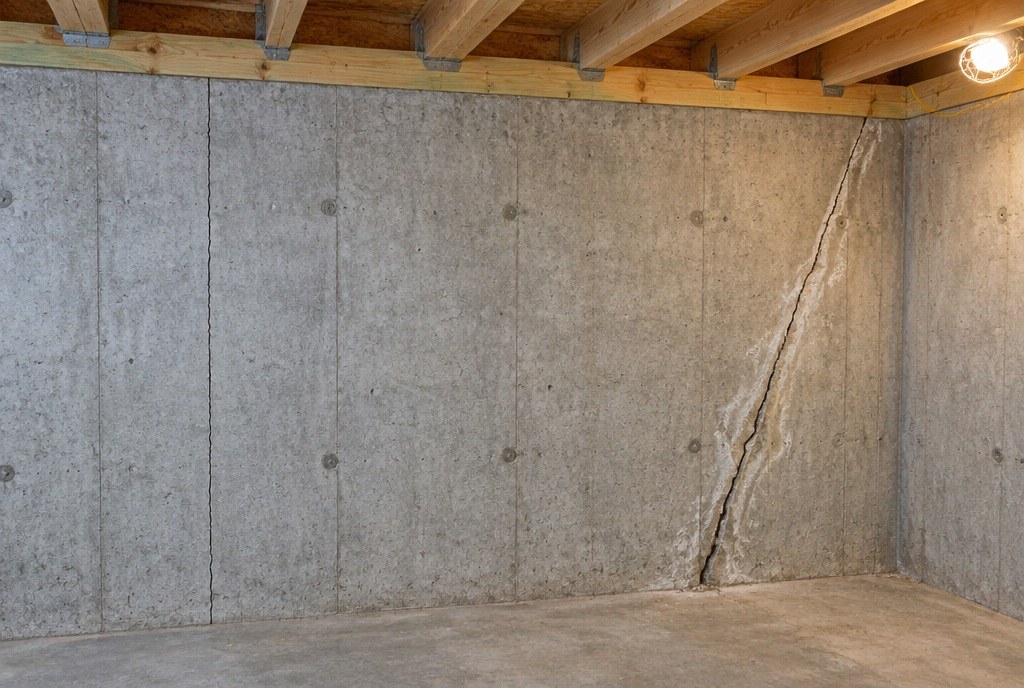
Illustration, not a real property. This one runs the full height of the wall, and that is the kind of crack that stops people in a basement. On its own it tells you very little. Length is not one of the four questions.
A crack is a symptom, not a diagnosis
Concrete is strong in compression and weak when it is pulled. It cracks to relieve stress, and the crack points back at where the stress came from. That is why direction and shape tell you more than length.
The four questions I ask of any crack:
- Which way does it run? Vertical, diagonal, horizontal or stepped.
- Is it the same width all the way along? Or wider at one end than the other.
- Is it offset? Run your eye, or a flat hand, across it. If one side sits proud of the other, something has moved, not just cracked.
- Is it wet, or has it been? Staining, a tide line, white mineral crust, or fresh paint on just that section of wall.
A crack that is thin, even, flush and dry is usually a crack. A crack that is wider at one end, offset, or wet is telling you something about the ground.
Know what the wall is made of
Poured concrete is the common one. It is cast in forms as one piece, and cracks show up as lines through the concrete.
Concrete block is laid in courses with mortar joints. It cracks along the joints, which is where the stepped pattern comes from, and it behaves differently under sideways pressure from soil.
Very old houses can sit on rubble or stone. The older-home post covers that. It is not automatically a problem, but it is read differently and repaired differently.
Vertical hairline cracks: usually shrinkage
Concrete loses water as it cures and gets slightly smaller. A long wall has to relieve that somewhere, so it cracks, often near the middle of a run or at a window or a corner where the shape changes. These can appear in a house’s first year.
What makes one ordinary: thin, roughly vertical, about the same width top to bottom, not offset, and dry.
What it can still do: let water in. A shrinkage crack is not a structural problem, but it goes right through the wall, and on the side of the house where the grade slopes the wrong way it can be the leak. So I still look at the floor below it and the wall around it.
Diagonal and wedge-shaped cracks: settlement
A crack that runs on an angle, or one that is noticeably wider at one end than the other, suggests part of the foundation has moved down relative to the rest. That is differential settlement, one corner or one section going down more than its neighbour.
The usual causes are ground underneath that was not properly compacted, soil that has been washed out or softened by water, or a footing that was not sized for what it carries. On a hillside lot that was cut and filled to make a building site, the fill side is the one I look at first.
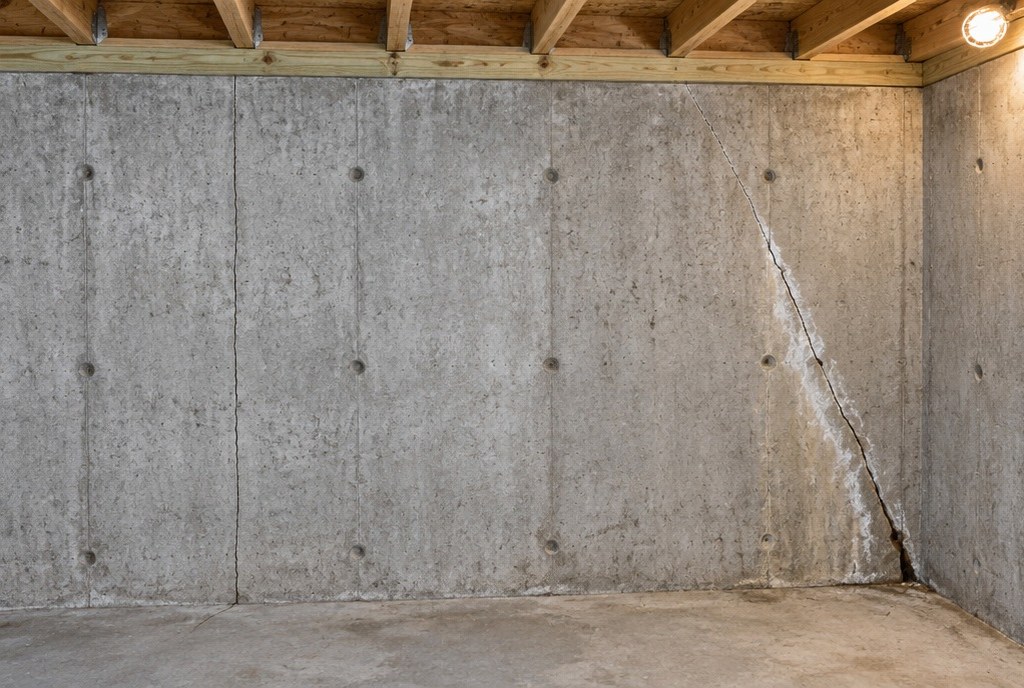
Illustration, not a real property. This one runs on an angle and opens up toward the floor, and there is a white mineral bloom along the lower half of it. Wider at one end means something moved. The white bloom means water has been coming through. Three of the four questions answered just by standing there looking at it, and the fourth one needs your hand.
What goes with it upstairs: doors that drift open or will not latch, sloping floors on the same side of the house, and diagonal drywall cracks running from the corners of doors and windows. One of those on its own is ordinary. Several on the same side of the house as a wedge-shaped foundation crack is a pattern, and a pattern goes on the list.
Horizontal cracks: pressure from outside
This is the one I take most seriously.
Soil outside a basement wall pushes sideways on it. Wet soil pushes harder, and frozen wet soil can push harder again. When a wall cannot take that, it can crack horizontally and start to lean or bow inward, often part way up the wall.
What I look for: a horizontal crack along a mortar joint in a block wall, or across a poured wall; a wall that is not straight when you sight along it; and any sign the top or middle of the wall has moved inward relative to the bottom.
A horizontal crack is not something to decide on from a walkthrough or a listing photo. It is a question for a structural engineer before you remove subjects.
Stepped cracks in block: settlement or pressure
In a block wall, the crack follows the mortar joints and climbs like a staircase. That can be settlement, one part of the wall going down, or it can be pressure, the wall being pushed. Which one it is changes the repair, and that is not a call to make by eye.
The same pattern shows up on retaining walls, and for the same reasons. The retaining walls post covers that side.
Offset cracks: something has moved
Any crack where one side sits proud of the other, in or out, up or down, has gone past cracking into movement. Direction matters less at that point. It goes to the inspector with a note that it is offset, and very likely on to an engineer.
Cracks in the basement floor
A basement floor slab is usually poured separately from the walls and sits on the ground inside them. It shrinks like any concrete, so thin cracks across a slab are common.
What I watch for is the same list: a section that has dropped or heaved, edges that are offset, or water coming up through a crack. A slab that has lifted can mean water or pressure from below. A slab that has dropped can mean the ground under it has moved or washed out.
Water, staining and efflorescence
Most foundation problems are really water problems. That is the reason the walkthrough post starts at the grade and the downspouts before it goes near the basement.
Efflorescence is the white, chalky or crusty deposit you see on basement walls. Water moving through concrete or masonry carries minerals with it. When the water evaporates at the surface, the minerals stay behind. It is not structural. It is proof that water has been coming through, and it tells you where.
Other signs water has been in:
- Tide lines or staining at the bottom of a wall
- Rust on the feet of shelving, the furnace or the hot water tank
- A musty smell in the basement
- Swollen or stained baseboards and drywall along an outside wall
- Fresh paint or a waterproof coating on one section of the wall and not the rest
That last one deserves a question. People paint what they want you not to look at.
Signs of a repair
A crack that was repaired is not bad news. It can be good news, if it was done properly and the cause was dealt with. What I want to know is what was done.
- A line of small plastic nubs along a crack usually means it was repaired by injection, with a sealant pumped into the crack through those ports.
- Fresh parging on the outside of the foundation, the thin cement coating above grade, can be maintenance or can be covering a crack.
- New drywall or new framing on one section of a finished basement wall, when the rest is original.
Ask: when was it done, why, who did it, has it leaked since, was an engineer involved, and is there paperwork or a transferable warranty.
A finished basement hides the wall
In a finished basement you cannot see most of the foundation. So I look where the finishes stop.
- The furnace and utility room, where the walls are usually left bare
- Under the stairs and in storage rooms
- The outside of the foundation above grade, all the way around the house
- Window wells, and whether they drain or hold water
- The ceiling of an unfinished section, for staining that came from above
What I can see there is a sample of the wall, not the whole wall. That is why the questions to the seller matter.
What to ask the seller
- Are you aware of any cracks, and when did you first notice them?
- Have any of them changed, grown or leaked?
- Has any foundation work been done, and by whom? Is there paperwork?
- Has an engineer ever looked at the foundation?
- Has the basement ever had water in it?
Get the answers in writing. A crack the seller has known about for twenty years and that has never changed is a different conversation from one that appeared last spring.
If you already own the house
If you are selling, or just want to know, one old habit is useful. Mark each end of a crack with a pencil line and the date. Check it every few months. A crack that stays inside its marks through a full year of seasons is behaving. One that has run past them is worth an inspector’s time before you list, not after a buyer’s inspector finds it.
The pre-listing inspection post covers whether it is worth getting ahead of that.
Who to call
- The home inspector looks at it first, as part of the inspection you should get anyway.
- A structural engineer if the inspector flags a horizontal crack, a bowing wall, an offset, a crack wider at one end, or signs it is getting worse. The engineer tells you what is happening and what the fix is.
- A foundation or waterproofing contractor for a quote, after the engineer, not instead of one. A contractor’s quote fixes what the contractor sees. An engineer’s report tells you what needs fixing.
On a subject period, that sequence takes time. Book the inspection early.
What this is not
This is not a home inspection and it is not an engineering opinion. I can tell you a crack looks like shrinkage or looks like movement. Only an inspector, and for movement an engineer, can tell you what it is.
It is not a price. I have deliberately put no repair costs here, because they depend on the cause, the wall, access and the contractor. A dry shrinkage crack and a bowing block wall are not in the same conversation. Get a real quote before you let a number change your offer.
It is not insurance, lending or legal advice. Whether a foundation issue affects your coverage is a question for your insurance broker. Whether it affects your mortgage is a question for your lender. What it means for your contract, or for disclosure when you sell, is a question for your lawyer.
Where this fits
- What I look at first on a walkthrough starts outside, at the grade and the downspouts, which is where most foundation problems begin.
- What to check in an older South Okanagan home is the full list for a house with some age on it, foundation type included.
- Retaining walls on hillside properties covers the other concrete and block structure that fails from water rather than strength.
- Buying in Wiltse and Valleyview covers stepped and walkout foundations on a slope.
- How to tell a well-built house from an expensive-looking one covers the drywall cracks and drifting doors upstairs that can point back down here.
- Reading a wood deck before you buy covers the ledger, where water behind a deck often shows up on the basement wall first.
If you are looking at a house with a crack in the basement and want someone to stand in front of it with you, email dano007@shaw.ca or call 250.488.0226.