Buying a fire-damaged house in Penticton: what the discount misses
By Dan Jones ·
Bottom line: a fire-damaged house is priced for the damage you can see, and most of the cost is in the damage you can’t. Heat cooks wiring well away from the flames. Smoke gets into wall cavities, attics and ductwork in rooms that never burned. And the fire department puts a lot of water into a house, which soaks everything the fire did not reach. A small fire that was properly repaired, with permits and paperwork, can be a sound buy. A house that was cleaned and painted, or sold as-is, is a bet on what is behind the drywall, and the discount does not always cover it.
I am Dan Jones, a REALTOR with Royal LePage Locations West in Penticton, licence number 1118346. I was a Red Seal journeyman carpenter from 1980, built custom homes and did renovation work before I was licensed in 2004. I built them for twenty-four years before I sold them, and I’ll tell you what’s wrong with a house, too.
Three kinds of fire-damaged house
“Fire-damaged” covers a lot of ground, and the three versions are not the same purchase.
Repaired properly. A kitchen fire or an electrical fire, contained to one area, repaired under permit, with the insurance scope of work and the final inspections on file. This can be a perfectly good house. The fire is history, and the paperwork shows how it was handled.
Repaired cosmetically. New paint, new flooring, maybe new drywall in the room that burned, and not much else. This is the one to be careful with, because it looks finished. The question is what was done behind the new surfaces, and whether anybody who knew what they were doing looked.
Not repaired. Sold as-is, often cheap, sometimes still boarded up. Nobody is hiding anything here. The price reflects the damage, but the size of the job is unknown until the walls are open, and that is the risk you are buying.
What a fire actually does to a house
Heat. Fire damages framing you can see, and the charred studs and joists are obvious. What is less obvious is how far the heat travelled. Wiring runs through the walls and ceiling from room to room, and the insulation on those wires can be damaged well outside the burned area. Heat can also weaken roof trusses and framing that look only darkened.
Smoke. Smoke goes everywhere air goes. Up the wall cavities, into the attic, through the furnace ducts, into the insulation. It leaves soot, and it leaves the smell. Painting over smoke-stained surfaces without cleaning and sealing them first is a common shortcut, and the smell tends to come back on the first hot day.
Water. People forget this one. Putting out a house fire takes a lot of water, and it runs down through floors, into subfloors, insulation and drywall, and into the basement or crawlspace. If the house was not dried out properly afterwards, that becomes a mould and rot question on top of a fire question.
What I look at
The same walkthrough as any house, starting outside, with a few additions.
Inside the house
- New work in one area only. A patch of new drywall, a run of new framing sistered onto old, newer wiring in one part of the house. Repairs leave a footprint, and the footprint shows you where to look hardest.
- The attic. Framing and roof sheathing painted over, often in white, can be a sign of smoke remediation, because a sealer is used to lock in smoke odour. That is not bad by itself. It means there was smoke up there, and it is worth asking what else was done.
- The smell. Fresh paint plus heavy air freshener plus windows open on a cold day is worth a question. Smoke odour in insulation does not paint out.
Systems and structure
- The electrical panel and the wiring. Whether the wiring in and around the fire area was replaced or just left, and whether that work had a permit.
- The ducts and the furnace. Whether they were cleaned or replaced. Soot in the ductwork gets blown through the whole house every time the heat comes on.
Below the floor
- The basement or crawlspace. Staining, a musty smell, or damp insulation under the area that burned. That is where the firehose water went.
None of it replaces an inspection. It tells you which questions to ask and which specialists you may need.
The paperwork decides it
With a fire-damaged house, the paper trail is worth as much as the walkthrough.
What to ask for
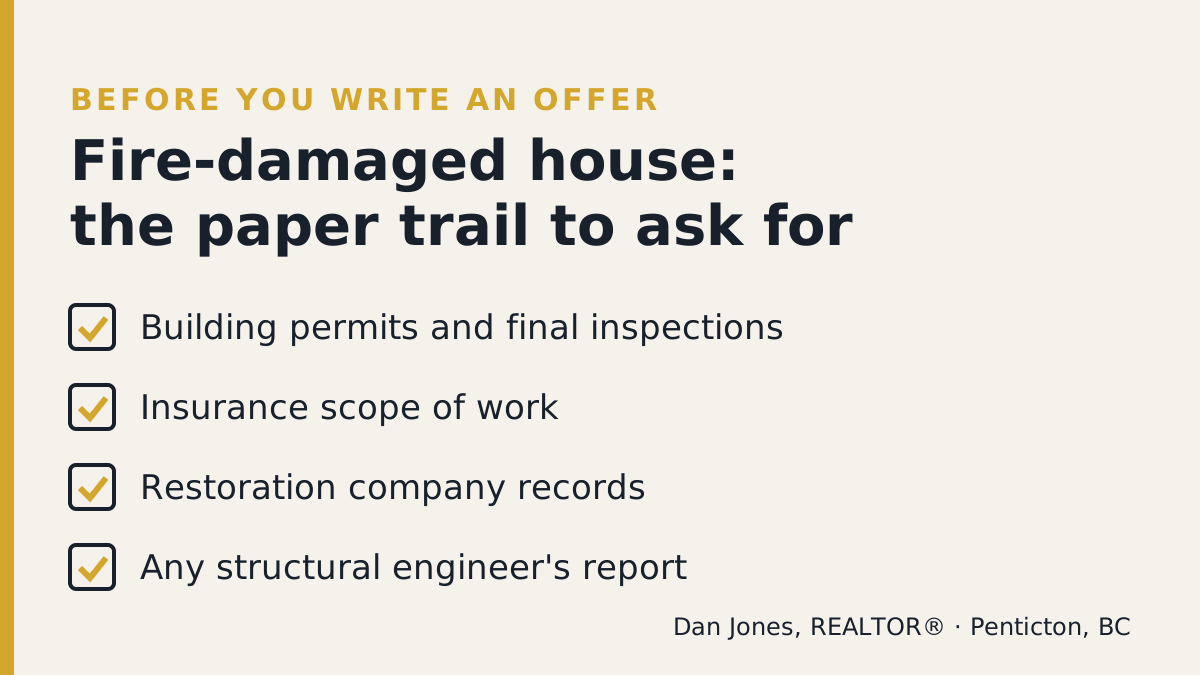
- Building permits for the repair, and the final inspections
- The insurance claim’s scope of work, which lists what was replaced and what was only cleaned
- Restoration company records, if a restoration firm did the cleanup
- Any engineer’s report on the framing
Why it matters
A repair with all of that on file is a known quantity. A repair with none of it means you are relying on the look of the finished surfaces, which is exactly what a cosmetic job is designed to get right.
BCFSA, the provincial real estate regulator, says sellers have a duty at common law to disclose material latent defects, meaning defects that cannot be found by a reasonable inspection, and it lists structural damage among its examples. Real estate licensees have a broader duty, which includes a defect that would involve great expense to fix and a lack of required permits. BCFSA also lists electrical or gas work done without permits and inspections as examples. Whether a particular fire has to be disclosed is a question for your lawyer, not for me. Ask the seller in writing either way, and read the property disclosure statement closely.
Older houses: test before anyone opens a wall
Fire repair means opening walls and ceilings, and in an older house that raises the asbestos question. WorkSafeBC says asbestos was widely used as a building material in BC until the early 1990s, and that you cannot tell it is there just by looking. In a house from that era, get a hazardous materials survey by a qualified professional before any demolition or repair work starts. Vermiculite and asbestos in older homes covers what that involves.
This matters for the budget as much as the safety. Abatement is a job of its own, done before the carpenters and electricians can start.
Buying a fire-damaged house in Penticton and the South Okanagan
The general points above apply anywhere. Locally, a few things change who you call.
- Permits go through the City. For a house inside Penticton, the repair or rebuild permits come from the City of Penticton’s building department, and the final inspections are on their file. Ask the City what is on record for the address. Outside city limits, in places like Okanagan Falls or Naramata, the permitting body is different, so find out which one applies.
- Older housing stock. A lot of Penticton and South Okanagan homes were built before 1990, so the asbestos and old-wiring questions come up more often here than in a new subdivision.
- Insurance. Insurers in this region already ask hard questions about older wiring and heating. A fire history adds to that, so get your broker’s answer on the specific address early.
- Local trades are busy. Restoration contractors, engineers and electricians who know the area can have waiting lists, so build that time into your subject period and your budget.
If you are comparing a burned or repaired house in Penticton, Summerland, Naramata or Okanagan Falls, I can tell you which questions matter for that specific property.
Repair or rebuild
On a badly damaged house, the real question is whether to repair it or take it down to the foundation.
A repair keeps what is sound and replaces what is not. That can make sense when the damage is contained and the structure checks out. A rebuild is new construction, with the City’s current permit process and today’s building code, and it takes as long as building any new house. Which one makes sense depends on how far the damage reached into the structure, and only a proper assessment answers that: a structural engineer, an electrician and a restoration contractor walking the house and quoting it. Do that before you decide what the house is worth to you.
When the fire takes the whole house
Everything above assumes there is a house left to repair. Sometimes there isn’t.
I flew my drone over one this spring: a large hillside home in the South Okanagan that burned down to its concrete walls. It was not my listing, and it has since sold, but it is a good example of what a total loss looks like. The roof and the floors were gone, and the rooftop pool was sitting empty in the middle of it. The contractor’s quote just to take the debris away was just over a million dollars. That was before anyone designed, permitted or built anything.
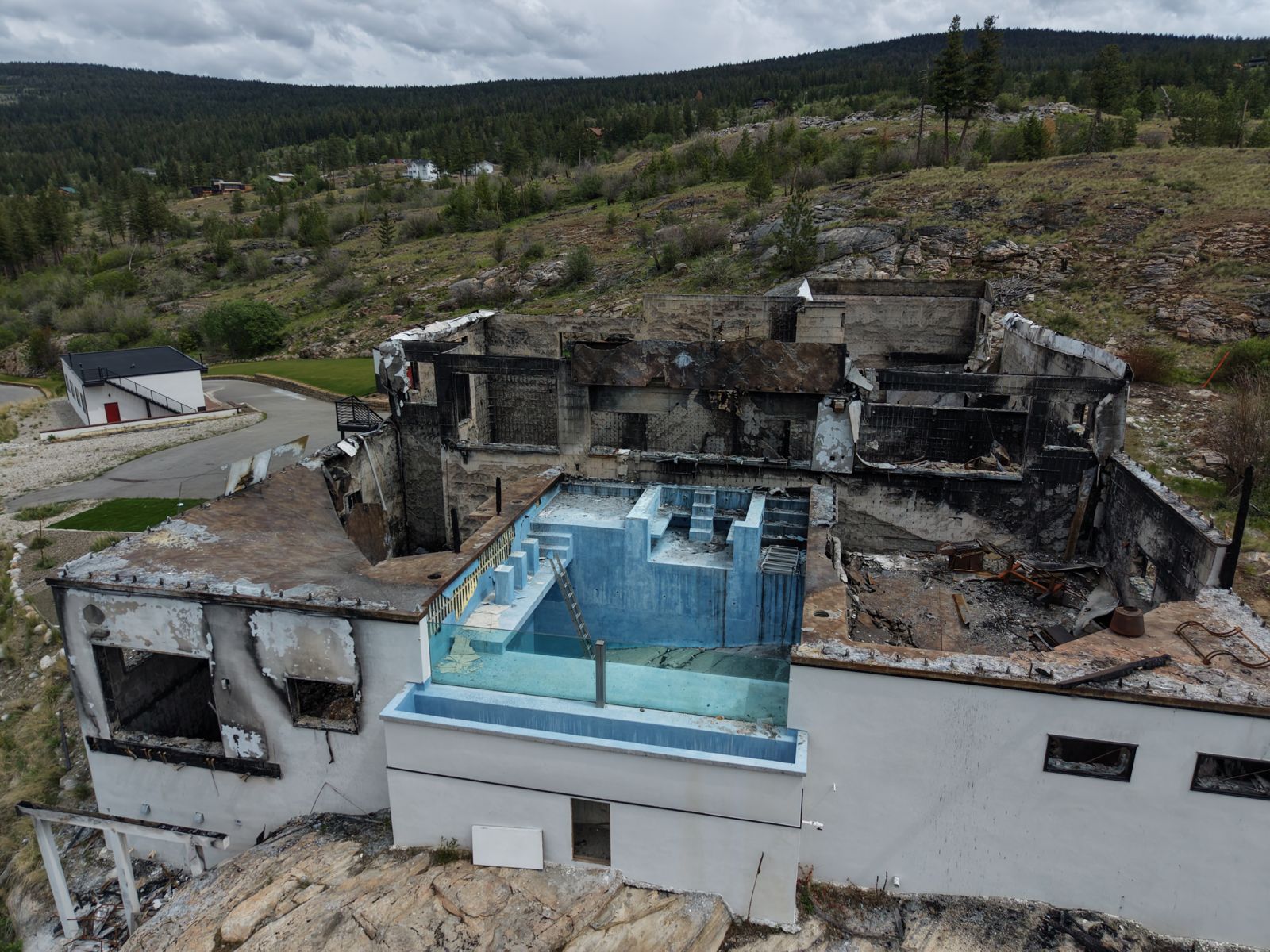
That is the part a low price on a burned lot does not tell you. Debris removal, and abatement if the building materials call for it, comes first, and on a big house it is a big job on its own.
Concrete walls still standing after a fire are not automatically walls you can build on, either. Heat can damage concrete and the steel inside it. Whether any of what is left can be reused is a question for a structural engineer, and until one has answered it, assume you are buying a lot with a very expensive cleanup attached.
Why the discount can cost you
The price of a fire-damaged house reflects what the market can see. The cost of the job reflects what is behind the walls, and nobody knows that until they are open. That gap is the risk.
The other costs are easy to miss:
- Time. Assessment, permits, abatement if needed, then the trades. You may be carrying the house while it happens.
- Insurance and financing. A fire history, an unrepaired house or an as-is sale can change what an insurer will cover and what a lender will lend on. Call your broker and your lender with the property’s history before you remove subjects.
- Resale. When you sell, a buyer will ask the same questions you are asking now. A complete paper trail answers them.
The fire itself is not the problem. The unknowns are. A buyer with a contractor’s quote, an engineer’s opinion and a clear answer from their lender and insurer is buying a project. A buyer without those is buying a guess.
What this is not
This is not legal, insurance or lending advice. Disclosure questions go to your lawyer, coverage questions to your insurance broker, and financing questions to your lender or mortgage broker. It is also not about wildfire risk or FireSmart work on a house, which is a separate subject.
Where this fits
- What I look at first on a walkthrough
- What to check in an older South Okanagan home
- Vermiculite and asbestos in older homes
- 60 amp electrical service and why insurers care
- How to tell a well-built house from an expensive-looking one
If you are looking at a house that has had a fire, walk it with me before you write an offer, and I will tell you what I see and which specialists to call. Email dano007@shaw.ca or call 250.488.0226.